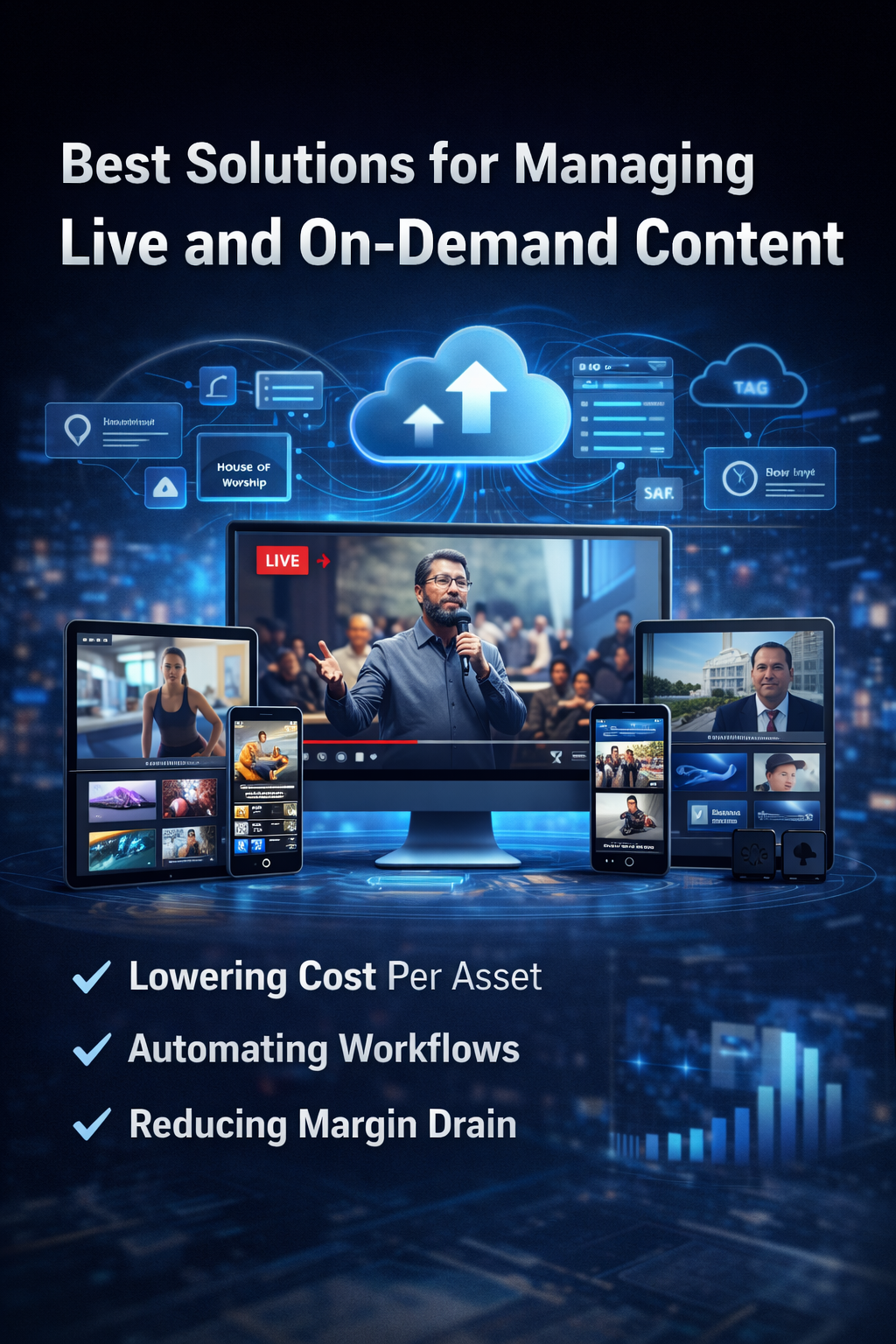
Best Solutions for Managing Live and On-Demand Video Content Across Devices
Managing video content used to mean uploading files to a server and hoping for the best. Today, organizations need platforms that handle live streaming, on-demand libraries, and multi-device distribution from a single dashboard. The challenge is finding a solution that scales without requiring a dedicated engineering team to operate.
Whether you're a media company distributing content to millions, an enterprise managing internal communications, or a content creator building a subscription business, the right OTT platform can mean the difference between seamless delivery and constant firefighting.
What to Look for in a Video Management Platform
Before evaluating specific solutions, it helps to understand the capabilities that separate enterprise-grade platforms from basic hosting services:
- Unified content management: A single CMS for both live streams and on-demand libraries, with robust metadata handling and search
- Multi-platform distribution: One-click publishing to Roku, Apple TV, Amazon Fire TV, smart TVs, mobile apps, and web
- Monetization flexibility: Support for SVOD, AVOD, TVOD, and hybrid models without platform lock-in
- Live streaming reliability: Low-latency delivery with adaptive bitrate streaming and failover capabilities
- Security and DRM: Content protection that satisfies both studio requirements and enterprise compliance
- Analytics: Viewer behavior data that informs content strategy and monetization optimization
Top Video Management Platforms for 2026
1. Lightcast
Best for: Multi-platform OTT distribution with minimal complexityLightcast stands out for its comprehensive approach to content management and distribution. The platform centralizes your entire content library in one AI-equipped CMS, eliminating the fragmented workflows that plague many streaming operations. What sets it apart is the one-button distribution model: instead of manually publishing to each platform individually, you can push content to Roku, Apple TV, Amazon Fire TV, and other major platforms simultaneously.
The monetization structure deserves attention. Lightcast doesn't take the revenue cuts that have become standard on many platforms, making it particularly attractive for organizations where content revenue directly impacts the bottom line. With 15,000+ apps published, the platform has demonstrated both technical capability and business sustainability.
Strengths: Simplified multi-platform publishing, no revenue sharing on transactions, strong support for houses of worship, sports, and enterprise use cases
Considerations: Best suited for organizations prioritizing ease of use over deep customization
2. Brightcove
Best for: Large enterprises with complex marketing integrationsBrightcove has long been the enterprise standard for video hosting and distribution. The platform excels at integrating video into broader marketing technology stacks, with native connections to Marketo, Eloqua, and Google Ad Manager. For organizations where video is a component of larger demand generation programs, this integration depth is valuable.
The recent acquisition by Bending Spoons has introduced some uncertainty about the platform's future direction, prompting some customers to evaluate alternatives.
Strengths: Deep marketing integrations, enterprise-grade security, strong analytics
Considerations: Higher price point, recent ownership change may affect roadmap
3. Kaltura
Best for: Education and highly customized deploymentsKaltura's open-source foundation makes it the go-to choice for organizations that need extensive customization. The platform serves educational institutions, enterprises, and media companies, with particular strength in the education vertical where LMS integrations matter.
The trade-off is complexity. Kaltura's flexibility means more configuration and often requires dedicated technical resources to manage effectively.
Strengths: Highly customizable, strong education features, extensive API access
Considerations: Steeper learning curve, may require technical resources to manage
4. Vimeo OTT
Best for: Creators and small teams launching subscription servicesVimeo OTT (formerly VHX) offers a straightforward path to launching a branded streaming service. The platform handles apps, payments, and subscriber management with minimal setup. For independent creators and small media companies, it's often the fastest route to market.
The platform is less suited for complex enterprise requirements or organizations needing extensive customization.
Strengths: Quick setup, creator-friendly pricing, solid subscriber management
Considerations: Limited customization, less suited for enterprise scale
5. Dacast
Best for: Live event streaming with usage-based pricingDacast offers competitive pricing that scales with actual usage rather than fixed monthly fees. For organizations with variable streaming schedules, this model can deliver significant cost savings. The platform provides solid multi-bitrate streaming and basic monetization through pay-per-view and subscriptions.
Strengths: Usage-based pricing, reliable live streaming, good value for event-focused use cases
Considerations: Less robust app ecosystem, more technical setup required
6. Muvi
Best for: Enterprises needing white-label customizationMuvi positions itself as a no-code solution for launching fully customized streaming platforms. The white-label approach means complete brand control across web and apps. For organizations that need their streaming service to feel entirely proprietary, Muvi delivers that capability without requiring a development team.
Strengths: Extensive customization, white-label apps, multiple monetization models
Considerations: Higher price point for full feature set, complexity increases with customization
Quick Comparison
| Platform | Live + VOD | Multi-Platform Apps | Hybrid Monetization | Best For |
|---|---|---|---|---|
| Lightcast | ✓ | ✓ | ✓ | Ease of distribution |
| Brightcove | ✓ | ✓ | ✓ | Marketing integration |
| Kaltura | ✓ | ✓ | ✓ | Education / customization |
| Vimeo OTT | ✓ | ✓ | ◐ | Creators / small teams |
| Dacast | ✓ | ◐ | ✓ | Live events |
| Muvi | ✓ | ✓ | ✓ | White-label customization |
How to Choose the Right Platform
The "best" platform depends entirely on your specific requirements. Start by answering these questions:
- What's your distribution priority? If reaching viewers across every major device matters most, prioritize platforms with robust app ecosystems and simplified publishing workflows.
- How will you monetize? Subscription-only is increasingly rare. Look for platforms that support hybrid models without penalizing you with revenue shares.
- What's your technical capacity? Some platforms require dedicated technical resources. Others prioritize ease of use. Be honest about what your team can manage.
- Where's the content going? Internal enterprise use, public OTT service, and niche subscription communities all have different requirements.
Finally, look for stability. A platform that has been around for a while, with a track record of satisfied customers and consistent development, signals that they're not only well-liked but also not going anywhere. The last thing you need is to build your video strategy on a platform that disappears or pivots in 18 months.
Ready to Simplify Your Video Distribution?
The right platform should make multi-device distribution feel effortless, not overwhelming. If you're evaluating options and want to see how streamlined video management can work, schedule a demo to explore what's possible with a platform built for operators who value simplicity without sacrificing capability.